
Peppered with problems
The Glitch:
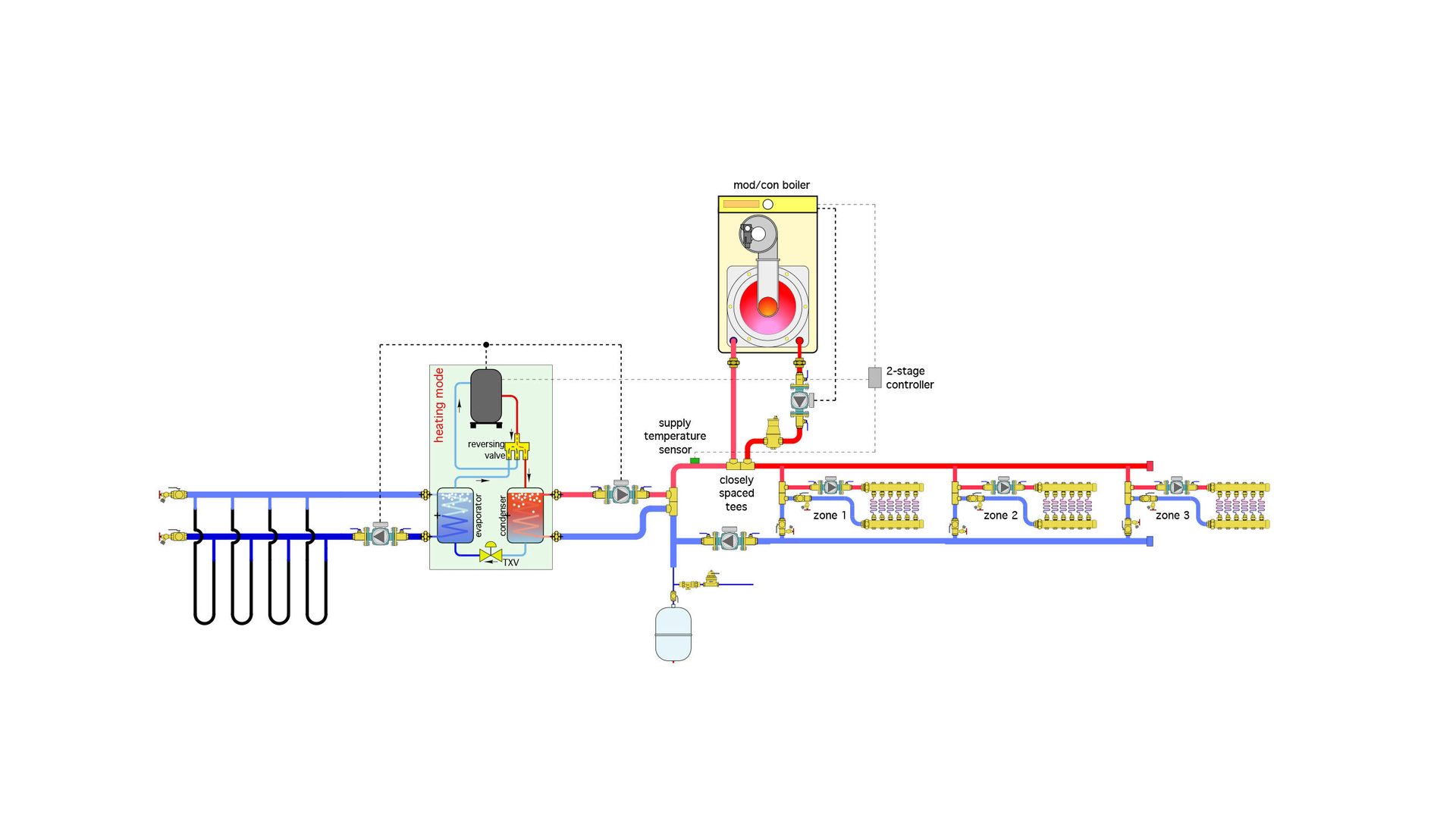
An installer is asked to create a three-zone radiant floor heating system using a 5-ton (60,000 Btu/h) single-speed geothermal water-to-water heat pump as the primary heat source, and a mod/con boiler as the auxiliary heat source. The heat pump is supplied by 4 earth loops made of 1” HDPE tubing, with each loop being 500 feet long.
Each of the three zones will have a six-circuit manifold station with nearly identical circuit lengths. All the floor heating circuits are underfloor tubing with aluminum plates stapled tightly to the underside of the subfloor, and well insulated.
The designer sets up a primary secondary system where each heat source connects to the primary loop using a pair of closely spaced tees, as shown in Figure 1.
ENLARGE
FIGURE 1
Each manifold station is also supplied from a pair of closely spaced tees installed in parallel “crossovers” of the primary loop. This keeps the supply water temperature to each manifold station approximately equal. The system has seven identical 1/25 HP circulators.
The installer provides two boiler drain valves to fill the earth loop and purge it of air.
The two heat sources are controlled by a 2-stage setpoint controller. When there’s a demand for heat from any of the zones the controller looks a the temperature at the supply sensor (Ts), and uses the following logic:
Stage 1:
If Ts ≤ 115° F then heat pump = ON
If Ts ≥ 117° F the heat pump = OFF
Stage 2:
If Ts ≤ 112° F then boiler = ON
If Ts ≥ 125° F the boiler = OFF
When put into operation, the heat pump short cycles. The boiler runs much longer than the heat pump.
Look over the system closely. Can you spot several details or settings that are either incorrect or missing? Can you propose an alternative design the would accomplish the same goals using less hardware?
Are you an ace troubleshooter?
Within the pages of this magazine, PM’s Hydronics Editor John Siegenthaler, P.E., will pose a question to you, our readers, to review a system’s schematic layout and discover its faults, flaws and defects. Discover archived “The Glitch & The Fix” exercises at its radiant-focused website, www.radiantandhydronics.com. Good luck!